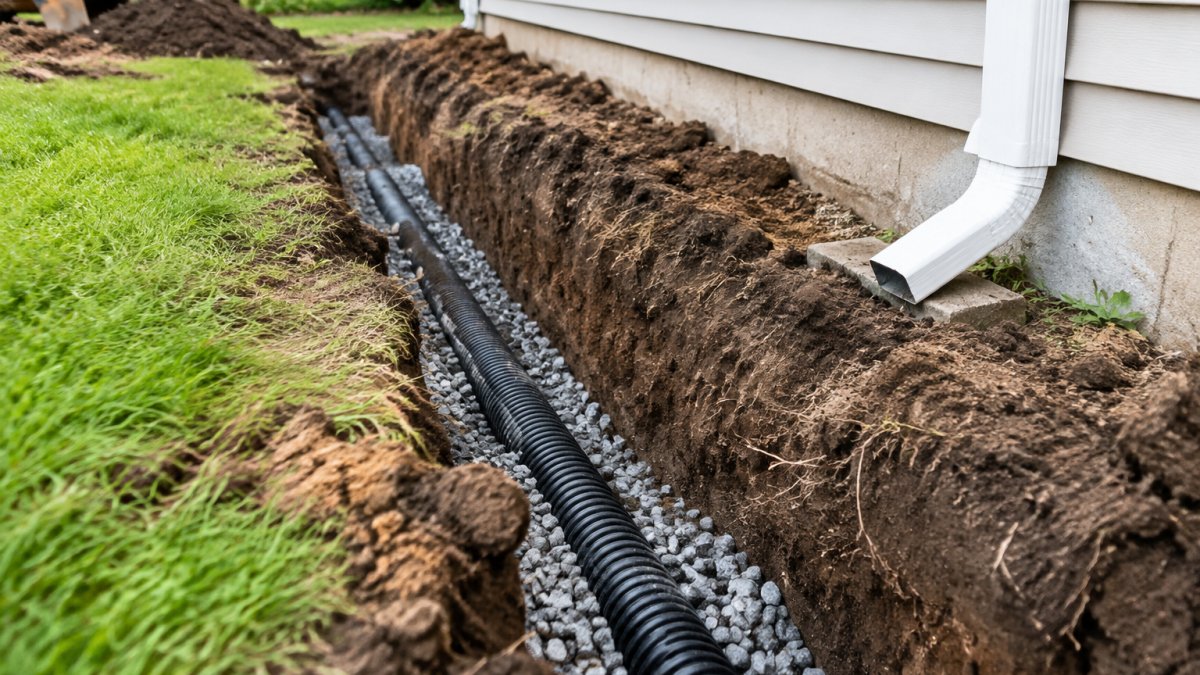
 how-to
How Does a French Drain Work: Trench, Pipe, and Slope
Last Updated: November 8, 2026
Quick Summary
A French drain is a gravel-filled trench with a perforated pipe that collects surface water and groundwater and carries it away from your foundation by gravity. Water enters the trench, filters through gravel, drops into the pipe through its holes, and flows downhill to a discharge point, no pumps, no power, no moving parts.
- The system relies on three things: porous material, a sloped path, and a clear outlet.
- Washed, angular 3/4-inch stone is common because voids stay open, while rounded pea gravel packs and closes them.
- The perforated pipe sits at the trench bottom, typically 4 inches in diameter, with perforations oriented up.
- Gravity pulls water along the pipe's fall, commonly about 1 inch per 10 feet of run.
- A 12-inch-wide, 18-inch-deep trench with a 4-inch pipe is a common residential baseline.
Table of Contents
- How a French Drain Moves Water Away From Your Yard
- How Does a French Drain Work Diagram: Step by Step
- Inside the French Drain Pipe: Perforations, Gravel, and Filter Fabric
- Does a French Drain Have to Be on a Slope?
- Frequently Asked Questions
How a French Drain Moves Water Away From Your Yard
A French drain is a gravel-filled trench with a perforated pipe that collects surface water and groundwater and carries it away from your foundation by gravity.
Water enters the trench, filters through gravel, drops into the pipe through its holes, and flows downhill to a discharge point, no pumps, no power, no moving parts.
The system relies on three things: porous material, a sloped path, and a clear outlet. Remove one, and the drain becomes a buried bathtub.
How Does a French Drain Work Diagram: Step by Step
- Surface water and gutter runoff pool on the lawn and seep downward; a French drain also accepts shallow groundwater once the water table rises into the trench.
- Filter fabric (a non-woven geotextile) lines the trench and wraps the gravel, catching soil particles before they reach the stone.
- Gravel fills the trench and creates void space; washed, angular 3/4-inch stone is common because voids stay open, while rounded pea gravel packs and closes them.
- The perforated pipe sits at the trench bottom, typically 4 inches in diameter, with perforations oriented up so water enters from above.
- Gravity pulls water along the pipe's fall, commonly about 1 inch per 10 feet of run.
- The discharge point releases water at a lower elevation, away from the foundation, ideally onto a splash block, graded swale, or dry well rather than a neighbor's lot.
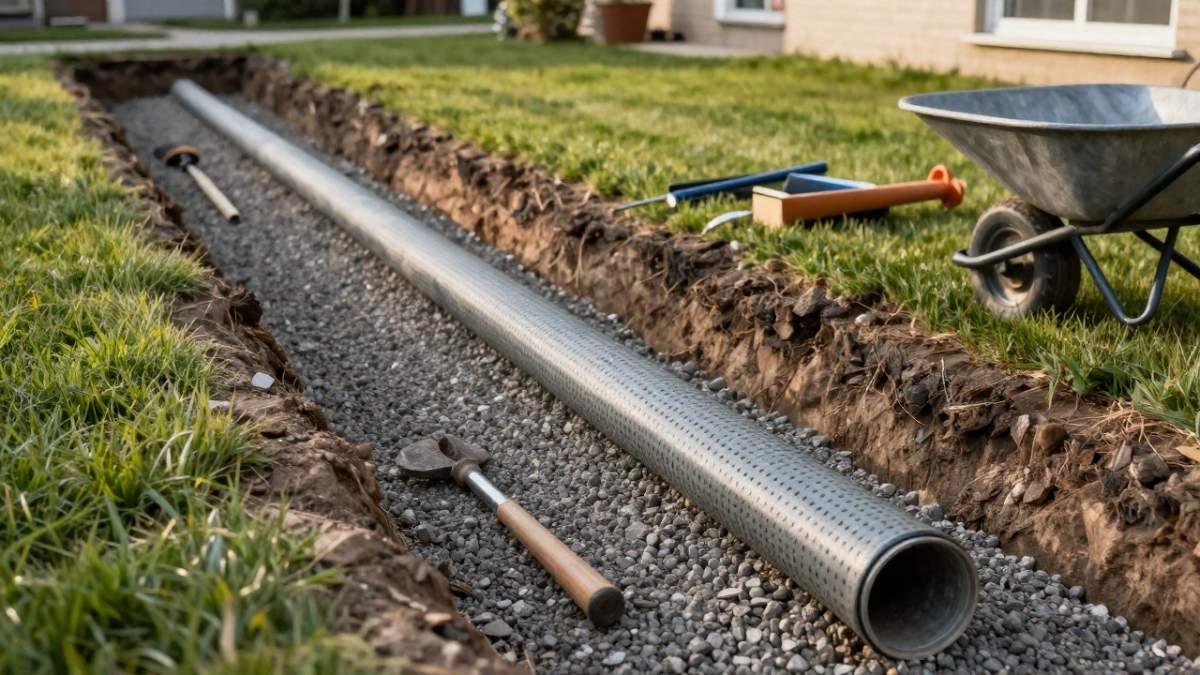
Each stage depends on the one before it. Clogged fabric and gravel filled with silt, a flattened pipe, or an undersized trench all cause a drain to fail in general.
Read the diagram by water volume, not just path. Gravel voids hold water temporarily while the pipe carries it away; if inflow exceeds pipe capacity, the trench fills and behaves like a buried bathtub. That is why trench width, stone size, and pipe diameter are matched to the drainage area, a 12-inch-wide, 18-inch-deep trench with a 4-inch pipe is a common residential baseline, but a long roofline or low corner needs more capacity.
Watch out: fabric installed shiny side out or with overlaps facing the wrong way can shed water instead of passing it, and torn fabric lets fines straight into the stone.
Here is the path water takes through a French drain, stage by stage.
| Stage | What happens | Key spec |
|---|---|---|
| Surface and gutter runoff | Water pools on lawn and seeps down; drain also takes shallow groundwater | , |
| Filter fabric | Non-woven geotextile lines trench and wraps gravel, catching soil particles | Non-woven geotextile |
| Gravel | Fills trench and creates void space for water | Washed, angular 3/4-inch stone |
| Perforated pipe | Sits at trench bottom with perforations oriented up | Typically 4 inches in diameter |
| Gravity | Pulls water along the pipe's fall to the outlet | About 1 inch per 10 feet of run |
| Discharge point | Releases water at a lower elevation away from the foundation | Splash block, graded swale, or dry well |
Inside the French Drain Pipe: Perforations, Gravel, and Filter Fabric
The French drain pipe is a rigid or flexible perforated pipe, typically 4 inches across, with holes that let water in while keeping gravel out. Point the perforations up so water enters from above, not down into the soil.
Around the pipe, washed gravel or crushed rock fills the trench. Avoid pea gravel; it shifts, packs tight, and blocks flow.
Filter fabric, a non-woven geotextile, wraps the gravel to keep sediment out.
Does a French Drain Have to Be on a Slope?
No, but it needs a fall somewhere. The pipe must drop continuously along its run so gravity can move water to the outlet. A common guideline is roughly a 1 percent grade, enough to keep water moving without scouring the pipe. Too steep and the pipe can daylight before the intended discharge point.
Sizing the fall. A flat-yard outlet that sits higher than the trench's natural fall will not drain by gravity alone, and you may need one of the options below.
-
Extend the run so the same total drop spreads over a longer distance.
-
Daylight the outlet to a lower spot: a curb break, graded swale, dry well, or storm sewer connection where local rules allow.
-
Regrade the surface so water sheds away from the foundation before it reaches the trench.
Where the water goes. The outlet should release water onto ground that slopes away from the foundation, ideally onto a splash block or riprap apron so it does not erode soil. Directing water onto a neighbor's property or into a sanitary sewer is commonly restricted; many jurisdictions regulate stormwater discharge and some require a permit. Check local rules before you trench.
- Inadequate slope, water stands in the pipe or the trench stays saturated long after rain. Check the fall with a laser level or string line.
- Blocked outlet, the trench fills and backs up even though the pipe is clear. Inspect the discharge point for roots, silt, or a crushed end.
- Sediment-clogged fabric or pipe, flow slows over seasons and the gravel looks fouled. Missing or torn fabric in clay soil accelerates this.
- Undersized system, the drain works in light rain but surcharges in heavy storms. Compare drainage area and roof runoff to trench and pipe capacity.
Maintenance and service life. Drain systems benefit from periodic inspection of the outlet and cleanouts, and flushing the pipe if flow slows. Clay-heavy soils, missing fabric, and shallow trenches generally shorten a system's life.
The French drain mistakes we see most often are flat pipe runs, outlets that dump water back against the foundation, and missing fabric in clay soil. Each turns a drainage fix into a repeat job.
If water pools in your yard after every storm, Boulders Excavation provides drainage corrections and French drain installations, along with the grading work that supports them. The team trenches, grades, and sets the outlet so water leaves the property.
Water that pools against your foundation will find a way in eventually. Fixing it starts with proper grading and a drain that actually discharges somewhere useful. Boulders Excavation brings trenching, drainage corrections, and expert grading to every job, so your yard sheds water instead of holding it. Get started with Boulders Excavation and turn that soggy corner into usable outdoor space.
Frequently Asked Questions
Does a French drain have to be on a slope?
It does not need much fall, but it needs some. Standard guidance calls for a grade of about 1%, so water moves by gravity toward the discharge point. A perfectly flat run lets water sit in the pipe and silt up. On a flat yard, a contractor can build slope by starting the trench shallower at the high end and deepening it, or by routing the outlet to a lower spot, a dry well, or a sump pump.
What are the most common French drain mistakes?
Common failures include pipe holes facing the wrong way, missing or torn filter fabric, and too little slope. Perforations should face down so water enters from below rather than soil washing in from above, and fabric should wrap the gravel so sediment stays out. Other frequent errors include discharging onto a neighbor's property, skipping the outlet entirely, and backfilling with clay-heavy soil instead of gravel. Any one of these can clog or stall the drain within a few seasons.
Where does the water from a French drain go?
Collected water has to leave the trench through a discharge point. Common outlets are a daylight pipe that exits at a lower grade, a dry well or gravel-filled pit, a storm sewer where local rules allow it, or a sump pump that lifts water to a safe exit. Before digging, confirm with your city or county where discharge is permitted, because dumping onto a neighbor's lot or into a sanitary sewer is often prohibited and can create a dispute or a fine.
